Going Gray

going-grayMaud Lavin of the Chicago Tribune wrote this review about my bookGoing Gray, What I Learned about Beauty, Sex, Work, Motherhood, Authenticity, and Everything Else That Matters:

“To read Anne Kreamer’s “Going Gray” is to enjoy that comfortable illusion that you are chatting with a friend. A friend whose confidences are told in a way that’s concise, entertaining and thoughtful.

“Going Gray” is Kreamer’s first book. It developed from a feature she did for More magazine about the process, when she was 49, of letting her hair grow out to show her natural gray after diligently dyeing it from age 25. This visible graying may seem like small potatoes, and she has the grace to acknowledge there are larger issues in life. But Kreamer skillfully uses that experience and its anxieties to explore thoughts about aging and femininity, and these are, of course, the memoir’s real hook.

buy-the-bookKreamer also takes an almost girlish, Nancy-Drew-detective approach to examining what other women — and some men — think about the cultural pressures and self-images that connect to dyeing hair, especially for midlifers. Although happily married, she wrote an Internet dating profile for herself pretending to be divorced and put it, along with a photograph of herself, on Match.com. At times she used one with dyed hair and at others one with gray locks, to compare how many responses she got. Those of you who, like me, already have a happy vanity about the lively gray streaks in your hair, will be pleased to know she got more approaches with her natural gray look. In addition, Kreamer hired a data-gathering business to conduct a national survey to learn more about attitudes toward graying.

For the reader interested in cultural shifts in attitudes toward women and aging, some of the most thought-provoking parts of Kreamer’s book are the contextual and historical perspectives she gives. She notes that fewer than 10 percent of American women colored their hair in the 1950s, compared with a reported 40 to 75 percent today. And her observation on the potential parallel between that statistical growth and a likely increase in women’s involvement with plastic surgery is a cogent one:

“In the national survey I conducted for this book, of four hundred women, average age forty-nine, 15 percent reported having had cosmetic injections or surgery — probably about the same percentage of middle-aged women who, back in the ’50s when the artificial-coloring boom began, dyed their hair. . . . Extrapolate the trend line, double the available technologies, and imagine the choices and pressures our great-grandchildren may face.”  (Maud Levin’s complete review.)

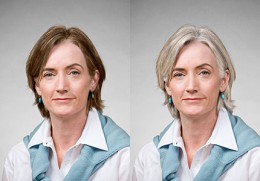
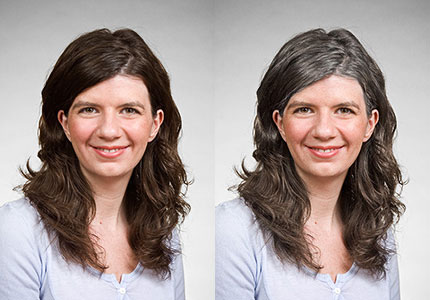
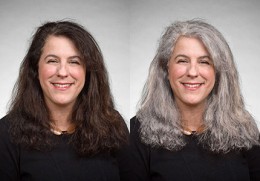
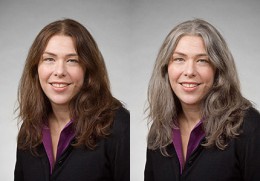
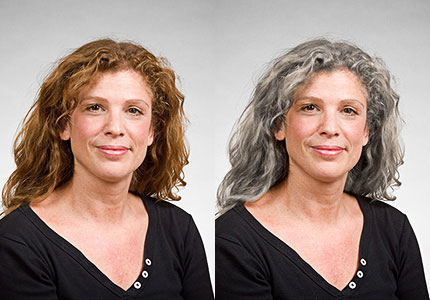
And here is the photo that started it all.


Comments

  1. I am working on going gray. Because I have a great hairdresser, she is progressively dyeing my hair to get closer to my natural color every few months. I’ll be there before the end of 2013. Gradual yes, but less scary for me.

  2. Vi en una revista, el comentario sobre tu libro y me encanto.
    Lo busque en internet y estoy muy contenta de tener con quien compartir este proceso de mis canas, ya que nos enseñaron que son significado de vejez, y no de experiencias de vida, y bueno algunas veces gnetico, pero cuando se ivan notando antes de tinturarlas decia que ya se me veian las experiencias y corria a la peluqueria. Al fin en mi “evolución” entendi lo que tu dices y es aceptarme como soy y no como quiero que me vean, osea aceptarme en mi propia piel.
    Quisiera saber si se consigue el libro en español, seria muy bueno para compartirlo con muchas seres que conozco.
    Felicidades. Un aBRAZO.
    Guadalupe Ruiz.

  3. When thinking that I might want to go gray, I asked my hair colorist his opinion. His response was”Oh, no, honey, you’re too young to go gray, it will age you sooo much.” So, I gave in and had another dye. But at the back of my mind, I knew I wanted to go natural gray. I decided on my 50th birthday that I would not touch dye again. One year later, my hair is silver, white down below my ears. The funniest part of this is the reaction of some older women. I’ve had perhaps a dozen well coiffed, dyed women around my age and older approach me with negative comments and some even offering a reference to a hair salon. It’s shocking to me, and rather than break my resolve, it just makes me stronger and more determined to grow long, long, gray hair. I’ve found that since I’ve been on this journey that it has been more than just about hair color. It’s about women being comfortable about aging and feeling good inside their own skin. It’s about knowing who you are, rather than depending on someone else telling you how to look. Thank you for this wonderful reference to look to when I need a pick me up because I just want to be me.

  4. Jo Ann Browning says:

    I am an African American woman who had a few strands of grey hair in highschool. I have medium to shoulder length hair and began to grey quickly around the age of 32. I have never dyed my hair. I am now in my 60′s with unusual hair that is a mix of grey, white and some natural brown streaks. Most of the time, I am pleased that I did not dye my hair. Most of the time, because of my unusual mix, people think I have had my hair professionally streaked. Why is it that when men have grey hair, they are considered to be distinguished. Yet women with grey hair must be older. Some things need to change, but they seem to remain the same!!! Congratulations in celebrating the sisterhood of beautiful, bold and blessed women with grey hair!!!!!

  5. I have grey hair. I know I look older witnh it but I don’t care. I get many compliments on my hair but no one goes grey from seeing me. I think most women just won’t do it.

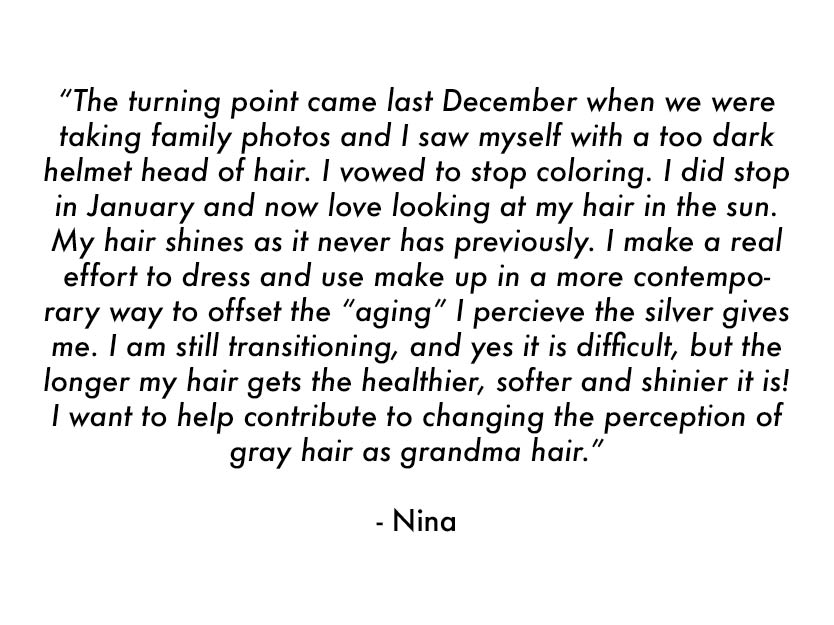
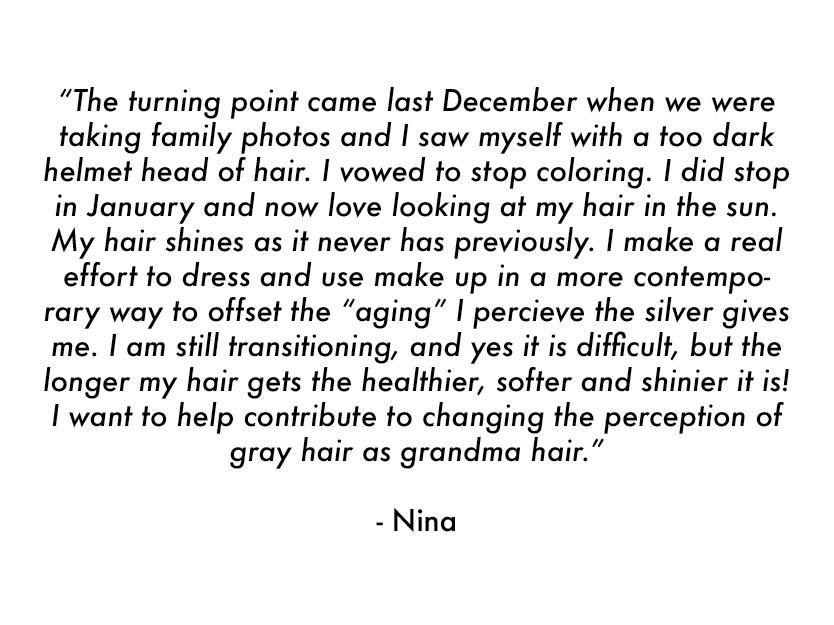
    • i forgot to say that I colored my hair all my life and just got tired of it. Actually, I love my hair now – really love it. My hair is very white and shines and I do everything to keep it pretty and with updated styles.

Speak Your Mind

*